

Whether you’re designing a high-pressure industrial pipeline or upgrading a commercial facility's plumbing, the integrity of your system comes down to its weakest links: the joints.
Make the wrong choice, and you risk catastrophic leaks, system downtime, and blown budgets. Make the right choice, and your system will run flawlessly for decades. Here is the ultimate guide to understanding the differences, advantages, and applications of both, so you can choose the right connection for your project.
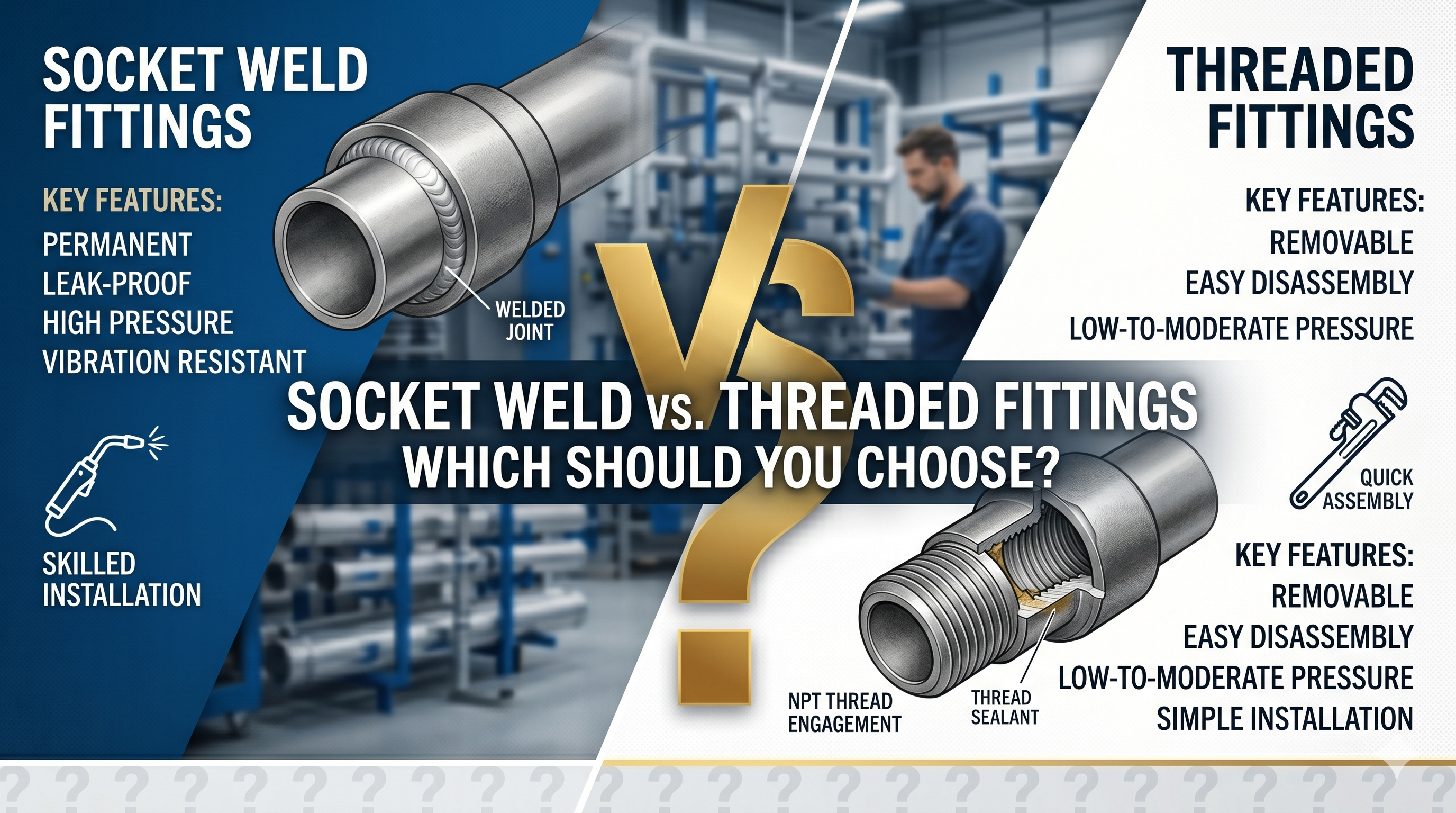
- Threaded Fittings: The Quick and Accessible Classic Threaded fittings connect pipes using internal and external threads. The pipe is screwed directly into the fitting, and the connection is sealed with Teflon tape or pipe dope.
The Pros: Speed and Simplicity: No welding required. Installation is as simple as threading the pipe and tightening it with a wrench.
No Hot Work Permits: Because there is no welding involved, threaded fittings are incredibly safe to install in hazardous, flammable, or explosive environments.
Easy Disassembly: If a section of the pipe needs maintenance, inspection, or replacement, threaded joints can be unscrewed and reassembled with relative ease.
The Cons: Prone to Leakage: Changes in temperature (thermal expansion and contraction) or high vibration can cause threaded connections to loosen and leak over time.
Weaker Structural Integrity: Cutting threads into a pipe naturally thins the pipe wall, making the joint physically weaker than the rest of the pipe.
Best For: Low-pressure, low-temperature, and non-hazardous applications. Think cooling water, instrument air, fire protection systems, and low-pressure steam.
- Socket Weld Fittings: The High-Pressure Heavyweight Socket weld fittings feature a recessed area (the "socket") where the pipe is inserted. Once the pipe is seated properly, a fillet weld is applied around the exterior to permanently join the pipe and the fitting.
The Pros: Exceptional Leak Prevention: Once welded, the joint is permanent and virtually leak-proof. It can handle high pressure, extreme temperatures, and heavy vibrations.
No Wall Thinning: Unlike threaded pipes, you do not cut into the pipe to make the connection, meaning the pipe retains its original wall thickness and structural strength.
Easier Alignment: The socket itself helps align the pipe before welding, making it easier for the welder to get a perfect fit compared to butt-welding.
The Cons: Permanent and Inflexible: Once it's welded, it's there for good. Maintenance requires cutting the pipe, which adds significant time and cost.
The "Crevice" Problem: Expert Insight: When installing a socket weld, standard practice dictates leaving a 1/16-inch (1.6mm) gap at the bottom of the socket to allow for thermal expansion during welding. However, this gap creates a small crevice where fluid can pool, making it highly susceptible to crevice corrosion in corrosive fluid applications.
Installation Costs: You need a skilled welder, specialized equipment, and hot work permits to install them.
Best For: High-pressure, high-temperature, and hazardous fluids (toxic, flammable, or radioactive) where leakage is absolutely unacceptable.
Head-to-Head Comparison To make your decision easier, let's look at how they stack up in four critical categories:
Leak Resistance Winner: Socket Weld. Because the joint is literally fused together with metal, socket welds offer vastly superior leak protection compared to the mechanical seal of a threaded fitting.
Installation Cost & Speed Winner: Threaded Fittings. Threaded fittings win the cost-efficiency battle hands down. They require less labor, zero specialized welding equipment, and allow for rapid assembly.
Maintenance & Accessibility Winner: Threaded Fittings. If your system requires frequent cleaning, component replacement, or internal inspections, threaded fittings allow you to unbolt and dismantle the system without taking a saw to your pipes.
High-Stress Environments Winner: Socket Weld. In systems dealing with heavy vibration (like near large pumps or compressors) or massive temperature swings, threaded joints will eventually back out or fail. Socket welds are built to endure continuous environmental stress.
The Verdict: Which Should You Choose? There is no "one size fits all" answer, but you can follow this standard industry rule of thumb:
Choose Threaded Fittings if:
Your system transports non-critical fluids (water, air).
Pressure and temperature are relatively low.
You are working in an environment where welding is too dangerous (e.g., active chemical plants where hot work is prohibited).
Budget and rapid assembly are your primary concerns.
Choose Socket Weld Fittings if:
You are dealing with high pressures, high temperatures, or hazardous materials.
The piping system is subject to heavy vibrations.
Long-term, leak-free reliability is more important than initial installation costs.
The fluid is not highly corrosive (to avoid crevice corrosion in the socket gap).
Need Help Sourcing the Right Fittings? Choosing the right connection type is just the first step—sourcing high-quality materials is the next. If you need standard-compliant, durable pipe fittings for your next project, explore our full catalog of premium threaded and socket weld fittings today.